

Legislative Advocacy in the UK
Introduction and Executive Summary
Legislative advocacy has long been a powerful tool for improving the lives of animals in the United Kingdom (UK).
More than 200 years ago, this intervention produced what is widely regarded as the world’s first modern animal protection law: the Cruel Treatment of Cattle Act 1822 (known as “Martin’s Act”, after its sponsor Richard Martin, a Member of the UK Parliament (“MP”)). This legislation had ripple effects throughout the globe, with countless other nations adopting similar laws in the decades and centuries that followed.
Whilst Martin’s Act was spearheaded by an MP, any animal advocate can engage in legislative advocacy. With the UK government’s Animal Welfare Strategy recently published in December 2025, now is a particularly opportune time to do so: ample opportunities will arise over the coming years for advocates to positively shape laws and policies being introduced to improve the lives of animals. This guide exists to help these efforts. It explains how different types of legislation are made and implemented in the UK; who is responsible for making and amending these laws; and how advocates can positively influence these processes. The guide also outlines the different practical tools that can be used by advocates conducting legislative advocacy and how to effectively engage with the different branches of the UK government.
In conducting legislative advocacy for animals in the UK specifically, advocates may wish to keep the following key points in mind:
In the UK, the real power largely lies with the Executive (the government). Courts cannot directly overrule legislation, and whilst Parliament is the supreme lawmaker, the government controls the legislative agenda, typically commands a House of Commons majority, and drafts bills through Whitehall departments. Effective advocacy therefore depends primarily on influencing ministers early in the policy process – while engaging MPs strategically to support and reinforce these efforts.
Animal welfare is a “devolved” competency. This means that the national parliaments in Wales, Scotland and Northern Ireland (the four nations composing the UK) can pass their own animal welfare laws, whilst the UK Parliament has only the authority to legislate in England. Nevertheless, some legislative measures will be adopted on a UK-wide basis.
When a bill is passing through the UK Parliament, the amending stages – the Committee Stage and the Report Stage – are particularly important. During these stages advocates may wish to find sympathetic MPs to propose and/or support amendments to strengthen the text, add new protections, or remove an unfavourable clause.
Private Members’ Bills can catalyse change. There is precedent for the UK government and devolved nations supporting private members’ bills on animal welfare or adopting their content into government bills.
The UK’s relationship with the EU is evolving: The UK is currently negotiating with the EU a common sanitary and phytosanitary area with respect to the movement of agri-food products. Depending on the scope of this agreement and the nature of any agreed exemptions, the UK may be required to dynamically align with EU farm animal welfare standards.
Secondary legislation – being delegated legislation made by the Executive under powers granted by Parliament – can often change animal welfare standards without requiring a new bill. This saves parliamentary time and is typically easier to secure – though it can be used to raise or lower standards.
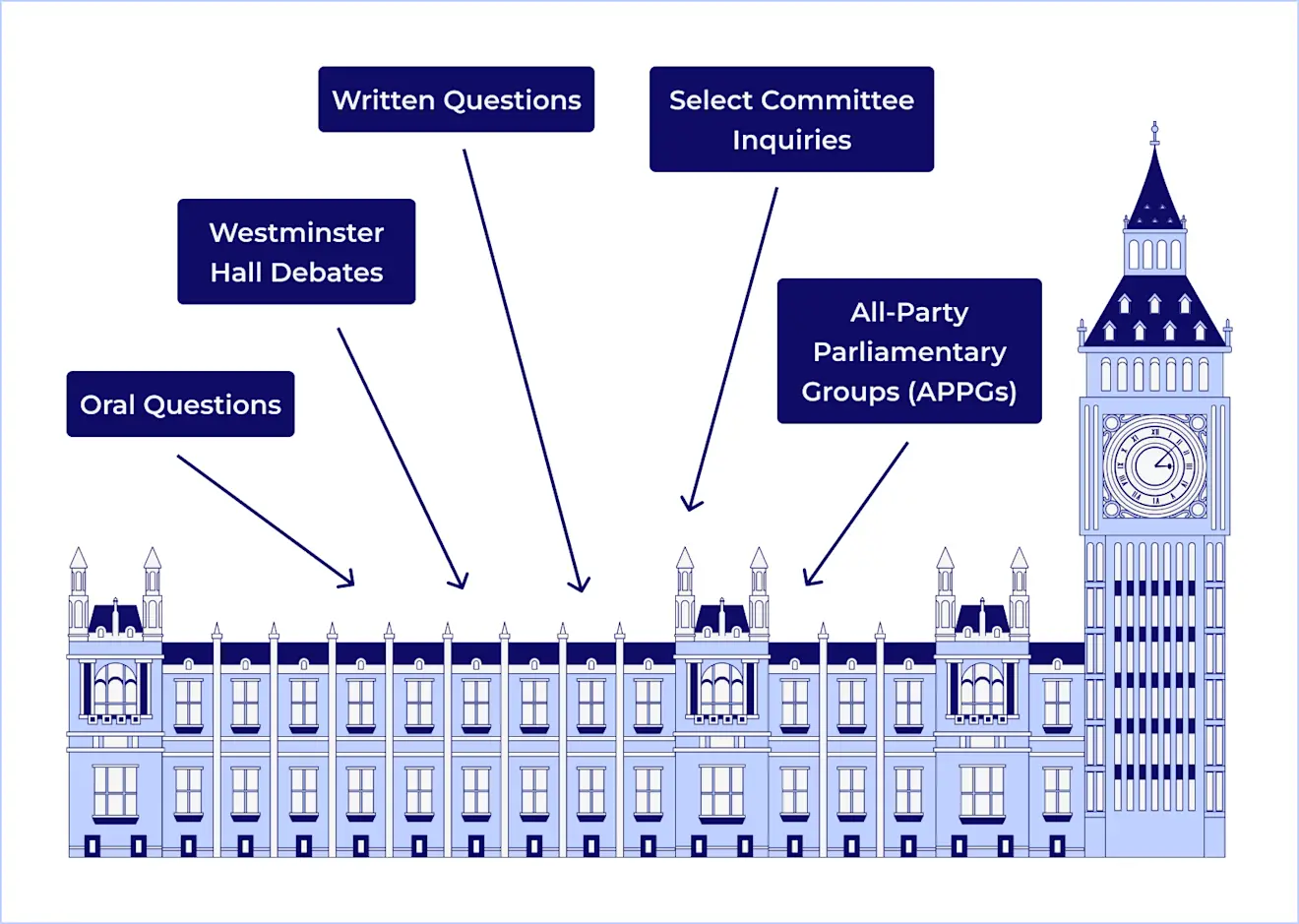
Legislative advocacy is a “long game” – and there are many tools available to keep important issues alive during the ebbs and flows of politics. These include Westminster Hall debates, written and oral questions, select committee inquiries, and engagement with all-party parliamentary groups. Each of these interventions can keep issues visible and on ministers’ agendas.
The Structure of the UK Government
The UK has three branches of government: the Executive, the Legislative (also called the Legislature), and the Judiciary.
The Legislature: The UK Parliament
The UK Parliament (commonly referred to as “Westminster”) is the key lawmaking body. It comprises two Houses: The House of Commons and the House of Lords. Both houses make laws, scrutinise the work of government, and debate national issues. The government cannot pass legislation or raise new taxes without Parliament’s agreement.
The House of Commons comprises 650 publicly elected MPs, who each represent a constituency in England, Wales, Scotland, or Northern Ireland.
The House of Lords has about 800 eligible members (the exact number fluctuates and is currently 828). These members, known as “Lords” or “peers”, are not publicly elected: most are appointed by the Monarch on the advice of the Prime Minister, whilst 92 sit by virtue of hereditary title (though a bill is currently progressing in Parliament which will remove hereditary peers). Some peers are affiliated to the main political parties, whilst others are independent (“crossbench peers”). Although the House of Commons is the more powerful chamber, the Lords can play an important role in scrutinising and revising legislation.
The UK Parliament includes MPs in the “Shadow Cabinet”, who lead the main opposition party’s policy positions and challenge their government counterparts, as well as “backbenchers” (MPs or peers that are neither government ministers nor opposition Shadow spokespeople).
"The UK Parliament (commonly referred to as “Westminster”) is the key lawmaking body. It comprises two Houses: The House of Commons and the House of Lords. Both houses make laws, scrutinise the work of government, and debate national issues."
Seats by Party in the UK House of Commons (2026)
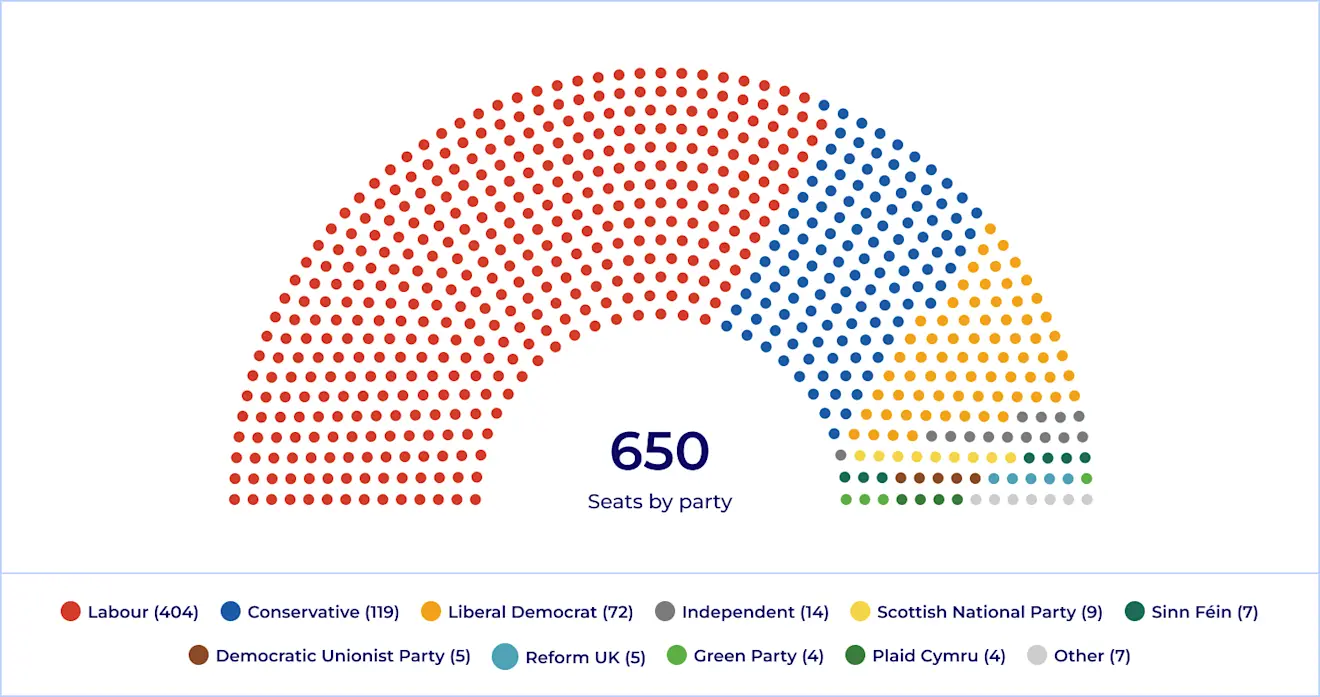
Animal advocates can approach MPs and peers to ask them to raise issues or press government ministers to take a particular action. The various parliamentary interventions that are available to MPs and peers are discussed further in section 4 below.
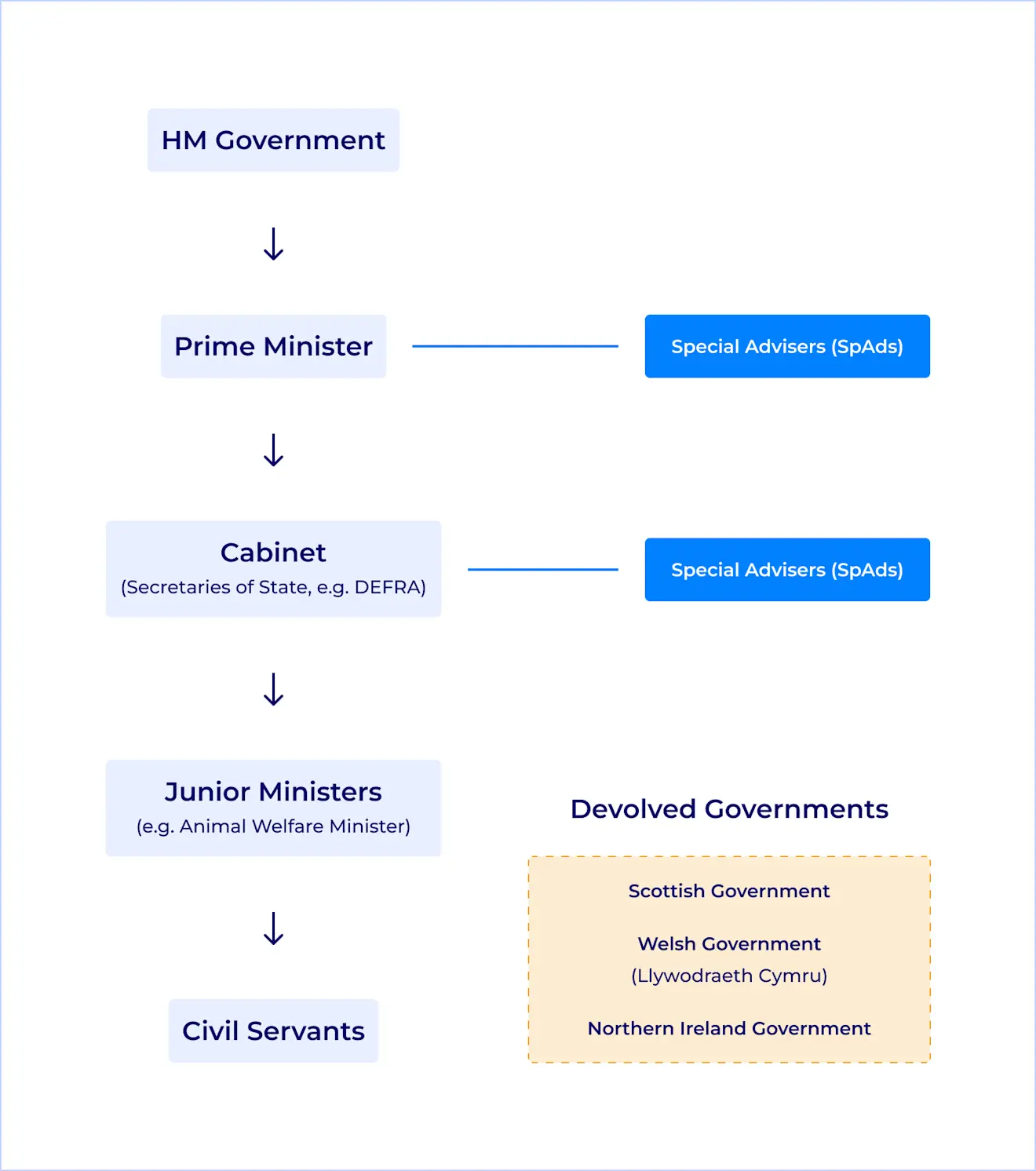
Structure of the UK Executive Branch
The Executive: The Government
In the UK, the political party that wins the most seats in the House of Commons in a General Election takes charge of the Executive branch – also known as “His/Her Majesty’s Government” or “HM Government” or simply “the government”. They are then responsible for running the country for up to five years, until the next General Election. The Executive branch comprises the Prime Minister, their Cabinet – a team of about 20 senior ministers who lead specific government departments, such as the Department for Food, Environment and Rural Affairs (“DEFRA”) – junior Ministers, and non-political civil servants. The Animal Welfare Minister (a Parliamentary Under-Secretary of State) is an example of a junior minister who serves as part of the Executive branch, with the support of civil servants in DEFRA. Senior civil servants can often have considerable influence on policy, particularly in complex or highly technical areas.
Each Secretary of State will usually have two or three special advisers (also known as “SpAds”). Special advisers are among the most powerful figures in government: they are politically appointed to support each Secretary of State on various aspects of departmental business and to provide advice, for example on key policy decisions. Often, special advisers can be more influential within a department than junior ministers. The Prime Minister also has his own special advisers, based in No. 10 Downing Street, the address of his official residence.
Whilst certain policy areas are devolved – meaning that the parliaments in Scotland, Wales, and Northern Ireland are responsible for them – some powers sit with the UK government alone. For example, only the UK government can enter into trade deals with other countries, which can have a significant impact on animal welfare. In addition, as England is the most populous nation in the UK, policy made at Westminster often affects the greatest number of animals.
"Whilst certain policy areas are devolved – meaning that the parliaments in Scotland, Wales, and Northern Ireland are responsible for them – some powers sit with the UK government alone.
For example, only the UK government can enter into trade deals with other countries, which can have a significant impact on animal welfare."
The Roles of the Different Branches of Government
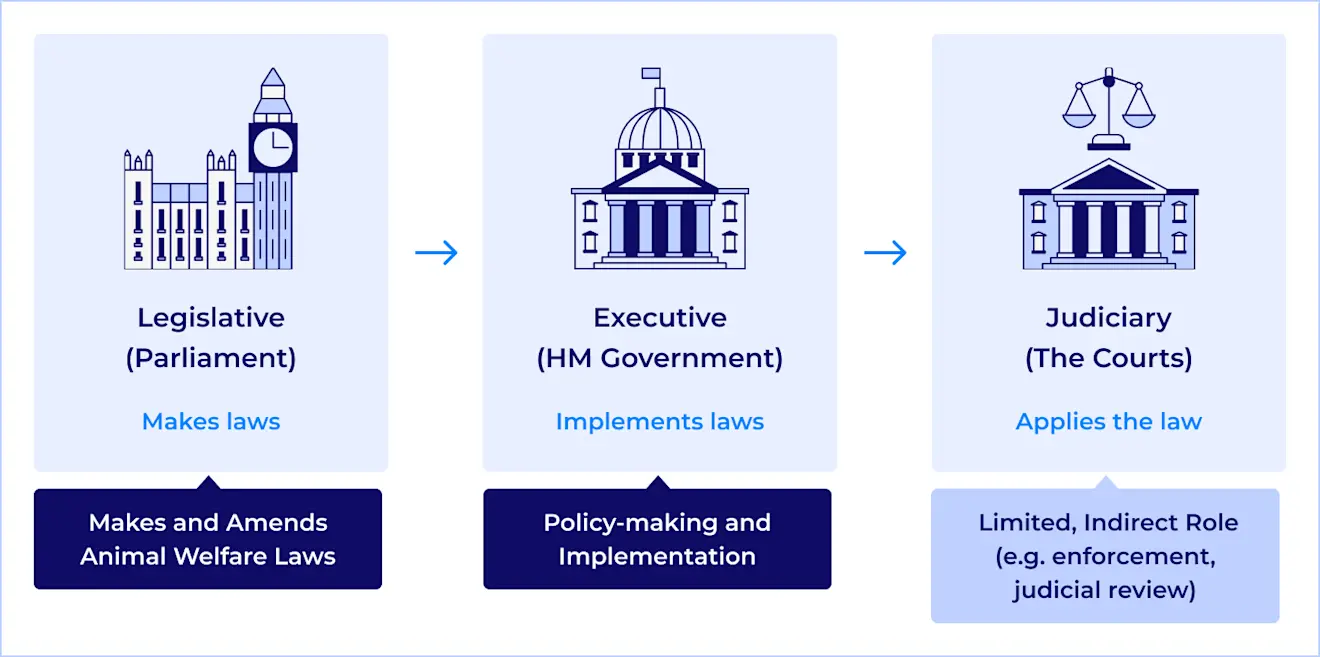
Power Dynamics Between the Executive and Parliament
It is worth emphasising just how powerful the Executive is. MPs – even those from the governing party – can rarely initiate legislation unless they win the private members’ bill ballot. In practice, they have little capacity to amend laws directly and must instead seek to influence the government. Opposition MPs possess even less legislative power unless strong cross-party consensus emerges against the government. When the government holds a solid majority – as it currently does – it almost never loses votes on bills. Moreover, only ministers may propose taxation or public spending, leaving backbenchers with virtually no formal role in such legislation.
Power dynamics differ in the House of Lords, where the government lacks a majority and legislation is more frequently amended or defeated. Individual peers therefore hold greater procedural influence, though legislative primacy still lies with the Commons, which can pass legislation without the Lords’ approval if certain conditions are met.
A key source of executive dominance is the UK’s highly centralised and disciplined party system. Government “whips”, who are MPs and peers appointed by the governing party to ensure their party colleagues vote in line with the government’s agenda, enforce party discipline by ensuring that their party’s MPs vote in accordance with the leader’s agenda, especially on key bills. Party loyalty is further rewarded through promotions and favourable committee appointments. Together, these features consolidate the Executive’s influence over Parliament.
The Judiciary The third branch of government is the judiciary.
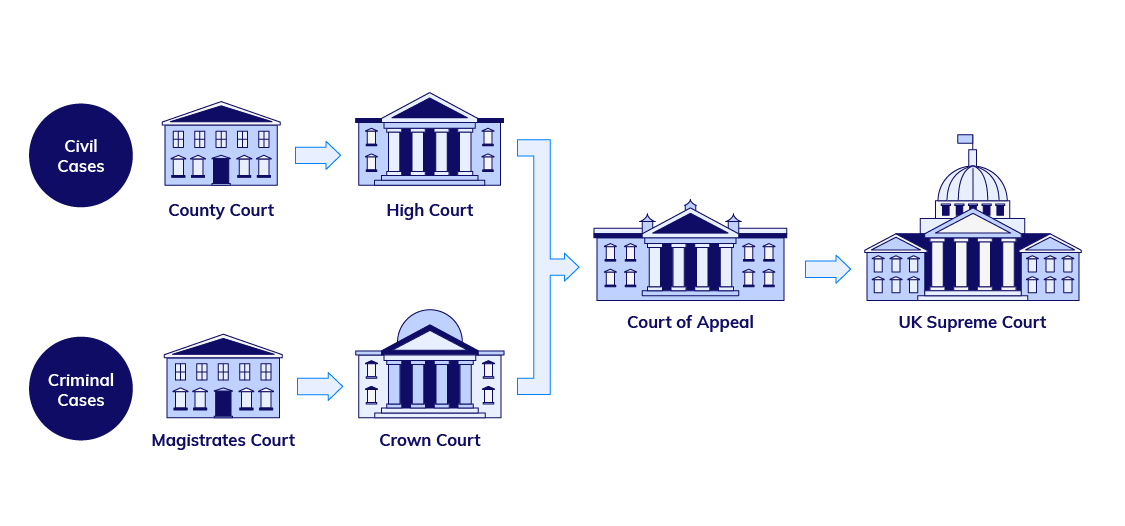
The UK has three separate judiciaries: England and Wales, Scotland, and Northern Ireland.
Criminal cases usually start in a Magistrates’ court, whilst more serious matters are referred to the Crown Court. Appeals from the Crown Court proceed to the Court of Appeal (Criminal Division) and in some cases, the UK Supreme Court. An example of a criminal case is a private prosecution brought against someone who has committed cruelty to animals.
Civil cases usually start in the County Court and can then be appealed to the High Court, Court of Appeal and the UK Supreme Court. An example of a civil case is a judicial review against a government department, for example a claim alleging that a decision they made in relation to an animal welfare standard was irrational, unlawful, or procedurally unfair.
Like many modern Western states, a cornerstone principle of the UK’s judicial system is the rule of law. One pillar of the rule of law is the notion that the judiciary is independent from other branches of government.
"It is worth emphasising just how powerful the Executive is. MPs – even those from the governing party – can rarely initiate legislation unless they win the private members’ bill ballot. In practice, they have little capacity to amend laws directly and must instead seek to influence the government."
The Structure of the Judiciary in the UK
This demarcation reflects the doctrine of the “separation of powers” – the idea that the three organs of government should be clearly divided so that no branch becomes too powerful.
One peculiarity of the UK’s system of government is that – unlike the vast majority of nations in the world – the UK does not have a codified constitution. It does, however, have an “unwritten constitution” which comprises various key pieces of common law decisions (i.e. decisions by the courts), statutes, and conventions. The defining principle of the UK’s constitution is the notion of parliamentary sovereignty: Parliament is the supreme lawmaker with the power to enact or revoke any law. Courts cannot overrule legislation and no Parliament has the power to pass a law that a future Parliament is prohibited to change.
For advocates, this matters. Unlike the US Supreme Court, UK courts cannot directly strike down legislation. Whilst litigation can still play a role, durable gains for animals typically come from Parliament and the Executive.
Devolved Parliaments
An important feature of the UK legal system is the notion of “devolution”. Devolution refers to the powers that the national parliaments in Scotland, Wales and Northern Ireland have to legislate in certain policy areas – as opposed to these being decided on a UK-wide basis by the UK Parliament.*2 Devolution resulted from successful referendums in Scotland, Wales, and Northern Ireland in the late 1990s, and resulted in the establishment of the Scottish Parliament at Holyrood, Edinburgh, the Senedd Cymru or Welsh Parliament in Cardiff, and the Northern Ireland Assembly in Belfast.
Importantly, animal welfare is – for the most part – a “devolved” competency. This means that the national parliaments in Wales, Scotland, and Northern Ireland pass their own animal welfare laws, whilst the UK Parliament can only legislate for England. Devolution has led to a divergence in some animal welfare standards. For example, Scotland and Wales have banned snare traps, whereas England has not (although the UK government has pledged to do so).
Similarly, Wales and Scotland have announced plans to ban greyhound racing, but there are no such proposals afoot in England. However, the devolved legislatures will often consent to Westminster animal welfare bills applying in their territories by passing Legislative Consent Motions which extend a bill’s provisions to their nations. For example, Wales recently consented to the Animal Welfare (Import of Dogs, Cats and Ferrets) Bill, and parallel consent motions are underway in Scotland and Northern Ireland.
*2 Unlike the competence framework established in the EU treaties or the constitutional division of powers between US states and the federal government, devolution in the UK is not constitutionally entrenched. Instead, it reflects a statutory transfer of powers granted by the UK Parliament to the devolved nations, which retains the authority to legislate on all matters, including in devolved areas.
"The defining principle of the UK’s constitution is the notion of parliamentary sovereignty: Parliament is the supreme lawmaker with the power to enact or revoke any law. Courts cannot overrule legislation and no Parliament has the power to pass a law that a future Parliament is prohibited to change."
"Animal welfare is – for the most part – a “devolved” competency. This means that the national parliaments in Wales, Scotland, and Northern Ireland pass their own animal welfare laws, whilst the UK Parliament can only legislate for England."
The UK’s Changing Relationship with the EU
After 47 years of membership, the UK left the European Union (EU) on 31 January 2020. The withdrawal of the UK from the EU, commonly referred to as “Brexit”, had significant consequences for the UK’s regulatory autonomy with respect to animal welfare. While the UK was part of the EU’s Single Market and Customs Union, it was required to adopt the EU’s common standards on farm animal welfare. This is no longer the case. Since Brexit, the UK has passed some laws which diverge from EU standards – for example, on 20 May 2024 the Animal Welfare (Livestock Exports) Act 2024 received royal assent, which made it an offence to export certain live animals from Great Britain for slaughter. Before Brexit, EU law would have prevented the UK from passing such legislation.
However, in May 2025, the UK signed a Common Understanding Agreement with the EU. This agreement set out principles governing the negotiation of a common sanitary and phytosanitary area for agri-food products (an “SPS Agreement”). If implemented as envisaged, most movements of animals and animal products between the EU and UK will take place without certificates and controls.
Whilst the SPS Agreement is still being negotiated as at February 2026, Parliament’s Environment, Food and Rural Affairs Committee (“the EFRA Committee”) has stated that it anticipates animal welfare during transport and at the time of killing will be within scope of the agreement. The EFRA Committee has further stated that it is not yet known whether on-farm animal welfare standards and method-of-production labelling will be within the scope of the agreement. Any areas that are within scope of the agreement would likely require the UK to adopt EU minimum standards – a regulatory process known as “dynamic alignment”. Importantly, the UK would likely retain its right to raise standards above EU minimums, as EU Member States can presently do. However, depending on the scope of the agreement and the nature and extent of any carveouts agreed, the UK’s ability to restrict (and potentially also to label) imports from the EU on low welfare grounds may be impacted.
"Since Brexit, the UK has passed some laws which diverge from EU standards – for example, on 20 May 2024 the Animal Welfare (Livestock Exports) Act 2024 received royal assent, which made it an offence to export certain live animals from Great Britain for slaughter.
However, the UK is currently negotiating a common sanitary and phytosanitary area for agri-food products. If farmed animal welfare standards are within scope of this agreement, the UK will likely be required to align with the EU’s farmed animal welfare standards unless a specific exemption is agreed."
UK Legislative Processes
Legislative Context
The United Kingdom has an extensive framework of legislation regulating the treatment of animals. Substantial gaps remain, however – allowing low welfare practices to persist. Core primary statutes include the Animal Welfare Act 2006 (applicable in England and Wales), the Animal Health and Welfare (Scotland) Act 2006, the Welfare of Animals Act (Northern Ireland) 2011, and the Animals (Scientific Procedures) Act 1986.
In addition to these statutes, a range of delegated legislation known as secondary instruments establish more detailed welfare standards for specific species or activities. Notable examples include the Welfare of Farmed Animals (England) Regulations 2007 and the Welfare of Animals at the Time of Killing (England) Regulations 2015, each of which has equivalent versions in the devolved administrations. Certain EU laws, such as Council Regulation (EC) No 1099/2009 on the protection of animals at the time of killing, also continue to apply.
Individuals and organisations seeking to influence or reform animal welfare law – whether by amending primary legislation, proposing new bills, or advocating changes to existing regulations – can do so by participating in the legislative processes outlined below.
Primary Legislation Introduced by Government
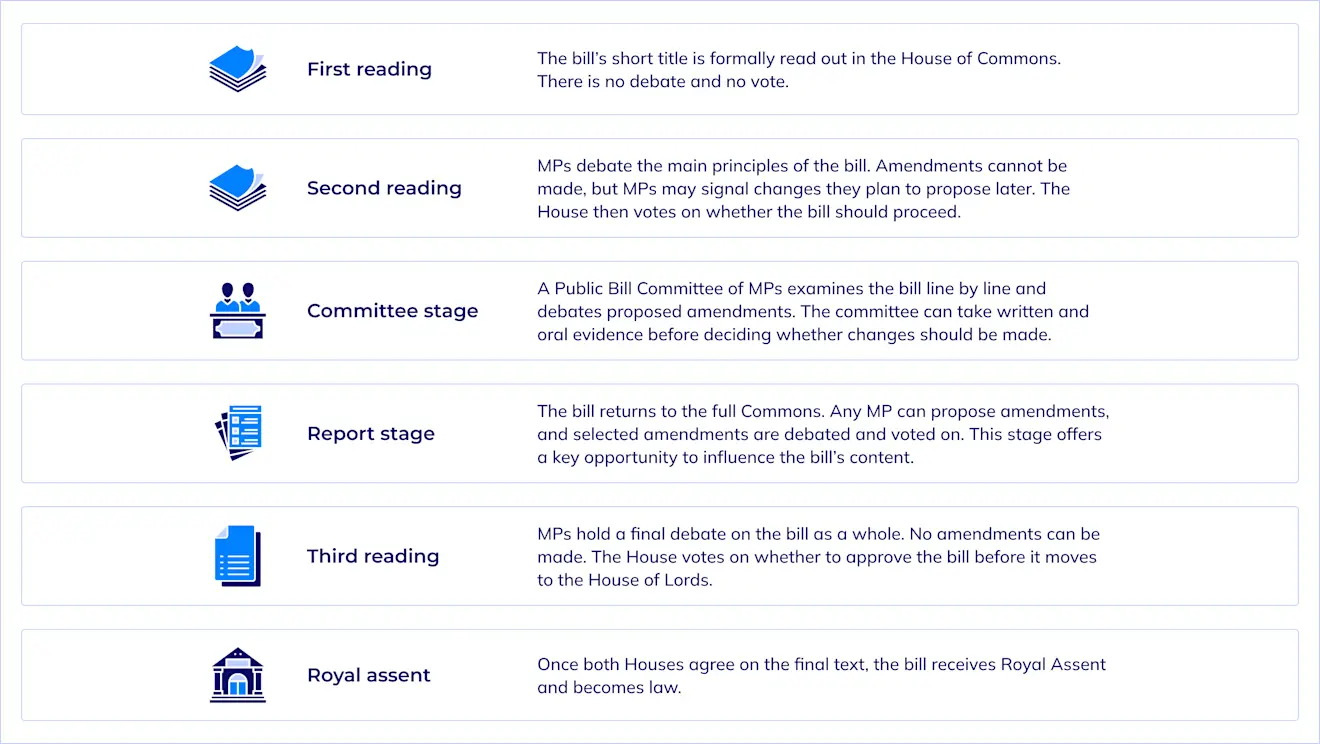
Primary legislation introduced by government can originate in either the House of Commons or the House of Lords. In the Commons, a bill must pass five main stages: first reading, second reading, committee stage, report stage, and third reading. Similar stages will follow in the Lords, and if the bill passes each stage it will receive “royal assent” and become law.
First Reading
The first reading is effectively a non-event: the short title of the bill is read out but there is no debate.
Second Reading
During the second reading, MPs debate the central principles of a bill. This will usually take place at least two weekends after the first reading. It is not possible to make amendments to the text of a bill during the second reading, but MPs may give an indication of the changes they intend to propose at later stages. Therefore, it is often helpful to provide MPs with briefings on the bill, alongside suggested amendments and supporting rationales, in advance of the second reading. At the end of the second reading, the House will vote on the bill. A simple majority will send the bill to the next stage, the Committee Stage.
Committee Stage
Committee Stage involves a Public Bill Committee comprising a selection of MPs (usually 17) and the Minister responsible for the bill, debating each clause of the bill, as well as any amendments that MPs have proposed.
Committee stage usually takes place within two weeks of the second reading. Animal advocates may wish to find MPs – who need not be on the committee – to submit amendments to the bill at this stage, and then find MPs – who do need to be on the committee – to move the amendments so that they can be debated.
Public bill committees have the power to receive written evidence from interested parties. Animal advocates can therefore use this process to recommend amendments to strengthen a bill. The Committee may also hear oral evidence, before carefully examining each clause of the bill and the amendments proposed to decide if they should stay in the bill. The Committee will then send the bill – in its original or amended form – back to the Commons for its Report Stage.
It is important to recognise the power dynamics within Committees: government whips decide which MPs sit on each committee. As a result, public bill committees tend to have a built-in pro-government majority and will rarely make material changes to bills unless the government agrees to them in advance. This makes it critical that advocates seek to obtain the support of Ministers, SpAds and civil servants in advance of Committee Stage.
"Primary legislation is the term used to describe the main laws passed by the legislative bodies of the UK e.g. Acts of the UK Parliament, Scottish Parliament, Welsh Parliament and Northern Ireland Assembly. These types of legislation are sometimes referred to as 'statutes'. During their passage through a parliament and prior to becoming law, they are usually called ‘bills’.
'Secondary legislation' is delegated legislation made by a person or body such as a minister or public body, under authority contained in primary legislation. For example, section 12 of the Animal Welfare Act 2006 confers upon the appropriate national authorities, which includes DEFRA, the power to make by regulations “such provision as the authority thinks fit for the purpose of promoting the welfare of animals.”
"Public bill committees have the power to receive written evidence from interested parties. Animal advocates can therefore use this process to recommend amendments to strengthen a bill."
Stages of a Bill in the House of Commons
Report Stage
Report Stage usually takes place about two weeks after the Committee Stage. During this stage, MPs debate the bill further and any MP can propose amendments – with the Speaker (the Chair of debates in the Commons) deciding which amendments should be debated and voted on. The report stage is therefore important, as it provides advocates with a valuable opportunity to influence a bill’s content. Advocates can engage in this stage by finding MPs to propose amendments to strengthen an animal welfare bill, or to propose (if relevant and within the scope of the bill) an animal welfare clause to a bill on an adjacent topic such as nature or trade.
The next stage is the third reading. This stage usually takes place immediately after the report stage and provides the final opportunity for MPs to debate a bill in the Commons. Amendments cannot be proposed at the third reading, and at the end of the debate the House votes on whether to approve the third reading of the bill. If a bill passes its third reading, it will then move through similar stages in the House of Lords. If any amendments are proposed by the Lords, these need to be agreed to in the Commons in a “consideration of amendments” stage before the bill can receive royal assent and become law.
"During the Report Stage of a bill, animal advocates can find MPs to propose amend-ments to strengthen an animal welfare bill, or to propose (if relevant and within the scope of the bill) an animal welfare clause to a bill on an adjacent topic such as nature or trade."
Secondary Legislation
Importantly, many reforms to protect animals do not require a new Act (primary legislation). Instead, Ministers use secondary legislation (usually regulations), also known as statutory instruments or “SIs”. SIs are made under enabling primary legislation – legislation which expressly empowers a Secretary of State to make regulations on a certain topic. For example, cages for farmed animals can be phased out in England using regulations passed under the Welfare of Farmed Animals (England) Regulations 2007 and mandatory animal welfare method-of-production labelling can be implemented via regulations under the Food Safety Act 1990. The ability to implement a reform using secondary legislation is a significant advantage; in requiring minimal or no parliamentary time, it is materially easier for the measure to become law.
There are two procedures used to pass secondary legislation. A minority – only about 25% – is made using what is called the “affirmative” procedure. This process requires both the Commons and the Lords to debate and approve a statutory instrument for it to become law. In practice, it is exceedingly difficult to have an affirmative instrument voted down – the last time the Commons did so was in 1978.
Further, most secondary legislation – about three-quarters – is made using a “negative procedure” which involves even less parliamentary scrutiny. Under this route, a minister signs off a statutory instrument which will automatically become law on its commencement date unless either House annuls it within the required period (usually 40 sitting days). No debate or vote on the SI will take place in parliament unless a member of either House tables a “prayer” motion to annul it. These motions rarely succeed – the last time the Commons annulled a negative SI was in 1979.
Accordingly, the nature of secondary legislation as delegated legislation made by the executive means that it involves significantly less parliamentary scrutiny compared with primary legislation. This is a double-edged sword: standards can be lowered as well as raised, with minimal parliamentary oversight.
Animal advocates can still influence the shape of SIs by responding to public consultations or calls for evidence which typically precede the Minister laying the instrument. In addition, unlike primary legislation, secondary legislation can be scrutinised by the courts in judicial review proceedings. This requires a claimant to prove that the SI involved illegality, irrationality or procedural unfairness on the part of the decision-maker responsible. Due to the large degree of deference afforded to Secretaries of States under UK law, these grounds are often challenging to make out.
"Many reforms to protect animals do not require a new Act. Instead, Ministers use secondary legislation (usually regulations), also known as statutory instruments or “SIs”. SIs are made under enabling primary legislation – legislation which expressly empowers a Secretary of State to make regulations on a certain topic."
Private Members’ Bills
Private Members’ Bills are introduced by MPs or peers who are not ministers. Few become law, but they raise the profile of an issue and can spur government action. In 1999, Maria Eagle MP’s bill to ban fur farming failed in Parliament but prompted the government to adopt the policy via a government bill the following year.
There are different types of private members’ bills available, including “ballot bills”. Ballot bills introduced in the House of Commons have the highest chance of becoming law, as these bills are allocated more debating time. Only 20 MPs will have their name drawn from the ballot in each (approximately year-long) parliamentary session. Animal advocates can reach out to these MPs to persuade them to dedicate their bill to an animal welfare measure (and to offer drafting support, where possible). MPs are often willing: for example, in the 2024-2026 parliamentary session, three private members’ bills addressed animal welfare issues – the Fur (Import and Scale) Bill, the Fireworks Bill and the Animal Welfare (Import of Dogs, Cats and Ferrets) Bill (which received government support and is now law).”
Case Study: Extending Legal Protections to Crustaceans
An example of successful legislative advocacy took place in November 2021 when the Animal Welfare (Sentience) Bill was amended to expressly include cephalopod molluscs and decapod crustaceans. Following years of campaigning by Crustacean Compassion and others, DEFRA commissioned an independent report by the London School of Economics into the evidence of sentience in these animals. The report answered affirmatively – resulting in the Animal Welfare (Sentience) Bill being amended to expressly include cephalopod molluscs and decapod crustaceans.

"Animal advocates can influence the shape of SIs by responding to public consultations or calls for evidence which typically precede the Minister laying the instrument."
"Private members’ bills can be used to raise the profile of an issue and can spur government action. In 1999, Maria Eagle MP’s bill to ban fur farming failed in Parliament but prompted the government to adopt the policy via a government bill the following year."
Legislative Advocacy
Effective legislative advocacy often requires engaging with both the Executive and Legislative branches. The UK Parliament, which is heavily dominated by the Executive for the reasons set out in paragraph 2.3 above, is responsible for passing and amending laws; the Executive then implements and enforces these laws once on the statute books. In addition, the Executive will regularly implement and amend rules affecting animals via secondary legislation. This division of responsibility also applies in the devolved nations.
The below section explains how to engage with the UK Parliament, the devolved parliaments, the Executive, and the devolved administrations, to ensure that strong laws are enacted in the first instance, and then robustly enforced.
How to Engage with the Legislative Branch
Legislative advocacy for animals is a long- term effort. Progress can be slow, but advocates have many tools at their disposal to keep important issues on Ministers’ desks. These include Westminster Hall debates, select committee inquires, the use of oral and written questions, and all-party parliamentary group events. These interventions can help to persuade the government to support a legislative measure that protects animals – or to drop harmful ones.
Westminster Hall Debates
Securing a debate in Westminster Hall, a part of the UK Parliament, helps to raise the visibility of an issue as it provides an opportunity for supportive MPs to speak passionately in favour of a given measure. A government Minister is required to attend the debate and present a response.
"Animal advocates can use Westminster Hall debates, select committee inquires, oral and written questions, and all-party parliamentary group events to persuade the government to support legislative measures that protect animals – or to drop harmful ones."
Legislative Advocacy Tools in the UK Parliament
One route to having an issue debated in Westminster Hall is to file an official e-petition. Any British citizen or UK resident can start a petition online at petition. parliament.uk. Once a petition reaches 100,000 signatures, the Petitions Committee will usually approve a debate on the topic. For example, in June 2025 a Westminster Hall debate on ending the use of cages and crates for farmed animals was triggered after a petition by Dame Joanna Lumley, spearheaded by Compassion in World Farming, reached over 100,000 signatures. Once a debate is secured, advocates should mobilise as many MPs as possible to attend the debate and speak in favour of the reform sought.
Advocates can also ask a supportive MP to apply for a Westminster Hall debate, which is usually determined by a ballot. To identify a potential champion, advocates can search the database of written parliamentary questions to find MPs who have previously filed written questions on animal welfare at https://questions-statements.parliament.uk/.
In recent years, numerous Westminster Hall debates have taken place on animal welfare issues. For example, in June 2025 a Westminster Hall debate that took place on animal welfare standards in farming. This debate saw a wide range of MPs speak out in favour of stronger laws to protect farmed animals, including mandatory method-of-production labelling and welfare at slaughter rules for farmed fish. These contributions helped to raise the salience of these issues in a forum in which a key decision-maker – the Farming Minister – was present. In addition, the debate highlighted the wide cross-party support that exists in favour of strengthening legal protections for farmed animals.
Written Questions
MPs and peers can file written questions which ministers must answer. This is a common intervention used to scrutinise the activities and policies of government, and advocates can therefore reach out to MPs and peers to suggest specific questions. For example, an MP or peer could ask a Secretary of State whether they have examined the merits of enacting a particular animal welfare policy, or when they intend to publish a consultation on a proposed animal welfare measure. Questions should be neutrally phrased and must not duplicate recent ones. All questions and answers filed since 2014 are searchable at https://questions-statements.parliament.uk/.
Oral Questions
Animal advocates can approach MPs requesting that they file a question to a relevant Secretary of State during Oral Questions. This will often be to the Secretary of State of DEFRA, but may also be to other departments, such as the Home Office (for example, if the matter concerns animal testing), or the Department for Business and Trade (for example, if the matter concerns the animal welfare impacts of a trade deal).
Oral questions usually take place once a month for each department while Parliament is sitting, and MPs must enter a ballot which will determine whether their question is selected. Due to the large number of questions usually submitted, particularly to DEFRA’s ballot, selection is highly competitive. Nevertheless, one major advantage of oral questions is that, unlike written questions which are typically answered by junior ministers, Secretaries of State will usually answer oral questions. Oral questions therefore present a valuable opportunity to bring an issue directly to the Secretary of State’s attention.
"Written questions are a common intervention used to scrutinise the activities and policies of government, and advocates can therefore reach out to MPs and peers to suggest specific questions. For example, an MP or peer could ask a Secretary of State whether they have examined the merits of enacting a particular animal welfare policy, or when they intend to publish a consultation on a proposed animal welfare measure."
Select Committee Inquiries
Advocates can engage with Parliamentary select committees – the most relevant one being the EFRA Committee. The EFRA Committee is a select committee of the House of Commons which scrutinises the work of DEFRA. The Committee comprises MPs from across the political spectrum – currently 11 – who conduct inquiries on policy issues relevant to DEFRA’s mandate, usually culminating in a report with recommendations which the government will file official responses to.
Opportunities to engage with select committees include filing written evidence in inquires relevant to animal welfare, proffering oral evidence (if invited), educating the Committee’s MPs on pressing animal welfare issues, and encouraging the Committee to include these topics within the remit of its inquiries. Through these activities, advocates can seek to gain the Committee’s support in recommending key reforms, which can be influential with ministers.
All-Party Parliamentary Groups (APPGs)
All-Party Parliamentary Groups (APPGs) are informal cross-party groups that hold events and publish briefings. There are currently APPGs for Animal Welfare, Phasing Out Animal Experiments in Medical Research, Cats, and Dog Advisory Welfare, among others. APPGs are generally sponsored by animal welfare NGOs who cover the cost of secretariat support, and they must include at least one MP or Lord from the government party (currently Labour) and at least one from the main opposition party (currently the Conservatives). Ministers will sometimes attend APPG events, and advocates can use their events and publications to bring attention to key issues. Moreover, if advocates have the resources and requisite parliamentary support, they can also establish a new APPG to address a specific animal welfare issue.
Legislative Advocacy in the Devolved Nations
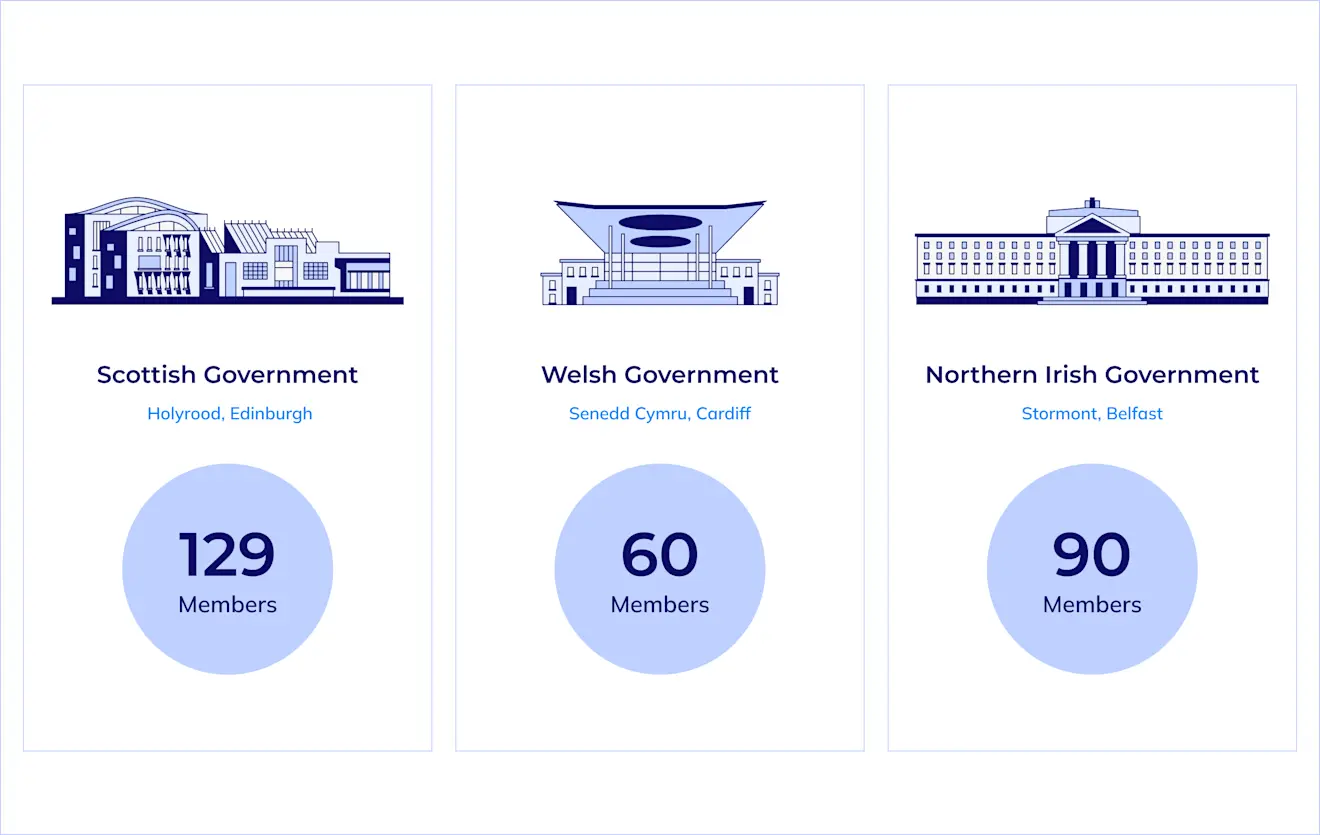
Because animal welfare is devolved, advocates can engage with the Scottish Parliament, the Senedd Cymru (Welsh Parliament), and the Northern Ireland Assembly. Unlike the UK Parliament which has two chambers (the House of Commons and the House of Lords), each devolved legislature is unicameral, meaning they only have one chamber.
The Scottish Parliament in Holyrood, Edinburgh, has 129 members who are elected every five years. The Scottish government is currently led by the Scottish National Party, who have 60 Members of the Scottish Parliament (MSPs).
The Senedd Cymru or Welsh Parliament in Cardiff comprises 60 elected members (increasing to 96 from May 2026), who are known as Members of the Senedd (MSs). Elections for the Senedd are held every five years. The Welsh government is currently led by Welsh Labour, which holds 29 seats.
The Northern Ireland Assembly in Belfast comprises 90 members, known as members of the Legislative Assembly (MLAs). Elections take place every five years. Northern Ireland has a power-sharing arrangements which require the largest political parties from both communities – unionists, who support Northern Ireland staying as part of the UK, and nationalists, who favour a united Ireland – to form a coalition government. The coalition government comprises the nationalist party, Sinn Féin, and the Democratic Unionist Party (DUP), with other parties assigned ministers.
"Animal advocates can engage with Parliamentary select committees by filing written evidence in inquires relevant to animal welfare, proffering oral evidence (if invited), educating the Committee’s MPs on pressing animal welfare issues, and encouraging the Committee to include these topics within the remit of its inquiries."
Governments in the Devolved Nations of the UK
After Brexit, the UK entered into two agreements with the EU, the Northern Ireland Protocol and the Windsor Framework. These agreements seek to avoid a hard border between Northern Ireland and Ireland (which is a member of the EU), by aligning Northern Ireland with certain EU laws and regulations, including on animal welfare during transport and at slaughter.
This means that the Assembly’s autonomy to regulate these issues is much more limited than in Scotland, Wales, or England. For example, the Animal Welfare (Livestock Exports) Act 2024 does not apply to Northern Ireland.
As in Westminster, in each devolved legislature the amending stages of a bill’s passage are critical. In the Scottish and Welsh Parliaments, amendments are made at Stages 2 and 3 (and a “Further Stage 3”, “Report Stage” and “Further Report Stage” in Wales, if these additional stages occur). In Northern Ireland, these are the Committee stage (when the committee considers amendments for the Assembly to vote on later), and the Consideration and Further Consideration stages (when amendments are voted on). Advocates can therefore work with supportive members during these stages to table or support amendments that strengthen protections or remove unfavourable clauses.
As in Westminster, advocates should begin outreach to the devolved government ministers and officials well in advance of these stages.
Private members’ bills (also known as “Members’ Bills”) also matter in devolved nations. While the process for advancing a members’ bill differs in each nation, there is precedent for them being used to strengthen the legal protection of animals. For example, Scotland’s plans to ban greyhound racing came about as a result of an MSP’s bill to ban greyhound racing: after the bill received cross-party support, the government announced in September 2025 that it would support the measure.
"As in Westminster, in each devolved legislature the amending stages of a bill’s passage are critical. Advocates can therefore work with supportive members during these stages to table or support amendments that strengthen protections or remove unfavourable clauses. As in Westminster, advocates should begin outreach to the devolved government ministers and officials well in advance of these stages."
"As in Westminster, members’ bills can be used in the devolved parliaments to strengthen the legal protection of animals. For example, Scotland’s plans to ban greyhound racing came about as a result of an MSP’s bill to ban greyhound racing."
How to Engage with the Executive Branch
Public Consultations
Most legislative proposals by government will involve a public consultation or call for evidence, which can usually be responded to online. Public consultations provide critical opportunities for NGOs, industry and the public to give feedback on the government’s proposals, which the government will then summarise and respond to. It is therefore important that a large volume of (ideally individualised) submissions are made in favour of positive reform proposals.
Each submission should provide cogent reasons in favour of the measure, which may include the legal, ethical, societal or economic impacts of the proposed policy, where relevant. Animal advocates should monitor the updates on animal welfare that are published on Defra’s website to keep track of when consultations open. Advocates can also sign up to DEFRA’s animal welfare e-alerts at https: //preferences.mailshot.defra.gov.uk/.
Consultations with Key Stakeholders
Some government consultations on animal welfare reform are targeted to key stakeholders only (usually select animal welfare NGOs and industry bodies). It is in the government’s discretion to determine which groups will be invited to participate.
Consultations with targeted stakeholders are commonplace as part of “Post-Implementation Reviews”. Under UK law, there is generally a duty on government departments to carry out a review of the effectiveness of secondary regulations every five years and to publish a report of its findings. For example, in June 2023 DEFRA sought evidence from animal welfare NGOs on the effectiveness of the Mandatory Use of Closed Circuit Television in Slaughterhouses (England) Regulations 2018, which require mandatory CCTV footage in slaughterhouses in England. The stakeholders consulted used this review as an opportunity to comment on the effectiveness of the regulations and to provide suggestions for improvement.
Other Forms of Outreach
Advocates can engage with the government’s Animal Sentience Committee, created by the Welfare (Sentience) Act 2022. This committee produces reports on the extent to which the government gave due regard for the ways in which a policy might have an adverse effect on the welfare of animals as sentient beings. The government is under a legal duty to present a response to the report within three months. Anyone can suggest policies for the committee to assess by contacting the committee’s Secretariat.
Other ways of engaging with the government include writing (or having supporters write) a letter to the relevant government department, asking a supportive MP or peer if they would be willing to speak with a Minister about a particular issue, or reaching out to civil servants to request a meeting. Groups can also host events at Parliament and invite relevant ministers and civil servants, for example to launch a new report. Hosting an event at Parliament requires finding an MP sponsor and the paying of hiring fees, and it can be an effective way to raise the profile of an issue.
In addition, animal advocates can work to improve the enforcement of animal welfare laws which are already on the statute books. In England, the enforcement of animal welfare laws is carried out by various bodies, including local authorities, the Food Standards Agency (FSA), and Defra, depending on the sector, with similar agencies responsible for animal welfare in the devolved nations. Advocates can play a key role in monitoring implementation and raising awareness of any enforcement gaps, thereby helping to ensure that legislative protections are effectively applied in practice.
"Public consultations provide critical opportunities for animal advocates to give feedback on the government’s proposals. Each submission should provide cogent reasons in support of favourable measures, which may include the legal, ethical, societal or economic impacts of the proposed policy, where relevant."
Resources
Institute for Government, “House of Lords,” (last visited February 5th, 2026).
University of Oxford, “How Does UK Government Work,” (last visited February 5th, 2026).
UK Parliament, “The Two-House System,” (last visited February 5th, 2026).
UK Parliament, “Parliament and the Government,” (last visited February 5th, 2026).
Institute for Government, “Special Advisers,” (last visited February 5th, 2026).
Judiciary.uk, Court and Tribunals Judiciary, “Structure of the Courts and Tribunals System,” (last visited February 5th, 2026).
UK Parliament, “How to Submit Written Evidence to Public Bill Committees,” (last visited February 5th, 2026).
UK Parliament, “Public Bill Committees,” (last visited February 5th, 2026).
UK Parliament, “MP’s Guide to Procedure,” (last visited February 5th, 2026).
UK Parliament, “What Happens in the Chamber at Second Reading,” (last visited February 5th, 2026).
Institute for Government, "Secondary Legislation: How Is It Scrutinised,” (last visited February 5th, 2026).
The Scottish Parliament, “About Government Bills,” (last visited February 5th, 2026).
Welsh Parliament, “Stages of Public Bills,” (last visited February 5th, 2026).
Northern Ireland Assembly, “Law Making in the Northern Ireland Assembly," (last visited February 5th, 2026).
The Coller Animal Law Forum is part of Jeremy Coller Foundation, a registered charity (No. 1163970) and a company limited by guarantee (No. 9696841) in England and Wales. | Copyright @ 2026